
Union Australasian Line To New Zealand and Australia Travel Poster
- ca 1920s
- Charles Edward Dixon (1872 - 1934)
-
25 x 40 inches ~ (63 x 101 cm)$3,200
- Unbacked
This poster is currently unbacked. At check out, you will be given the opportunity to add backing which would cost $145 and take approximately 6-8 weeks.
Linen backing is the industry standard of conservation. Canvas is stretchered and a sheet of acid free barrier paper is laid down. The poster is then pasted to the acid free paper using an acid free paste. This process is fully reversible and gives support to the poster. A border of linen is left around the poster and can be used by a framer to mount the poster so that nothing touches the poster itself. Backing is what we recommend for framing, and for any poster needing restoration.
- Add to Cart Add to Wishlist E-Mail Us About This Poster
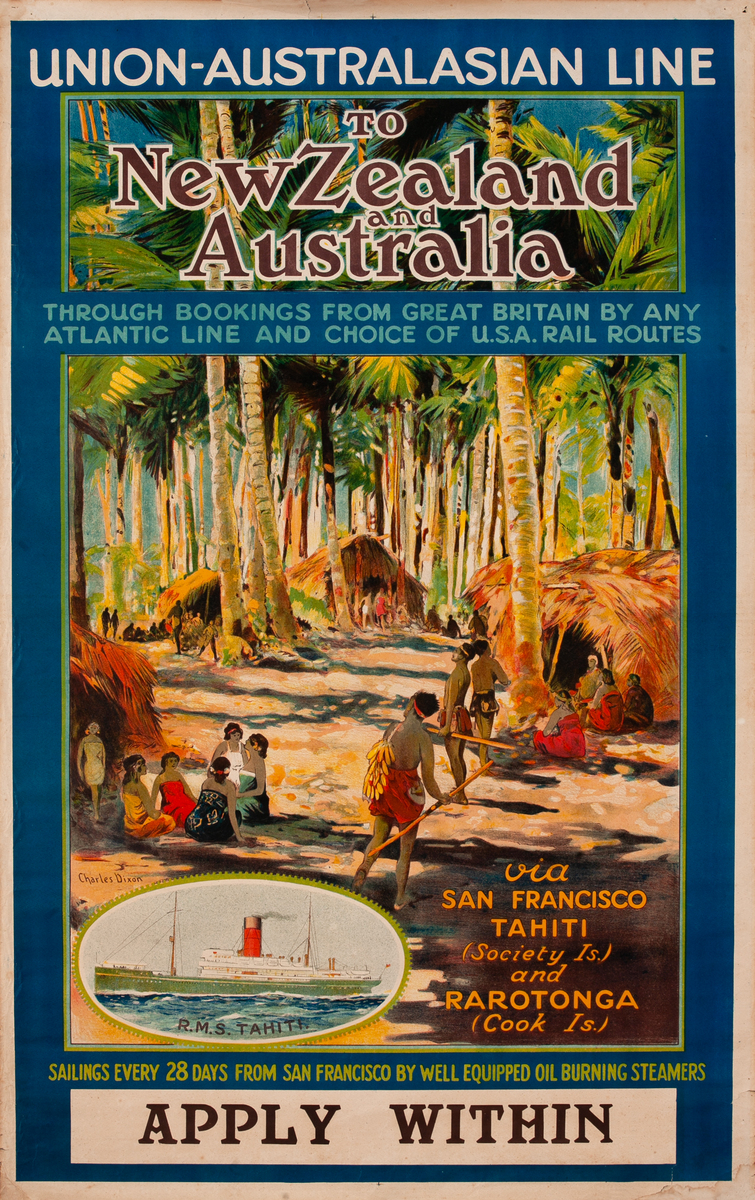
Union-Australasian Line to New Zealand and Australia
Through bookings from Great Britain by any Atlantic line and choice of USA rail routes.
via San Francisco - Tahiti (Society Is.) and Rarotonga (Cook Is.) R.M.S. Tahiti Sailings every 28 days from San Francisco by well equipped oil burning steamers.
Apply Within
Rare and wonderful Union Australasian Line poster of a colorful tropical scene with palm trees, thatched huts, and crowds of natives in traditional cotumes going about their their daily activities. An inset showcases the R.M.S. Tahiti steamship.
RMS Tahiti was originally built as the RMS Port Kingston in 1904 for Imperial Direct West India Mail Co. In 1911, she was purchased by the Union Steamship Company of New Zealand, refitted at Bristol and renamed Tahiti. She was intended for the route Sydney to San Francisco via Wellington, Rarotonga and Tahiti; she made her first voyage on 11 December 1911.
Charles Edward Dixon, was a British maritime painter of the late nineteenth and early twentieth centuries, whose work was highly successful and regularly exhibited at the Royal Academy.

Explore Similar Posters